
Daddy Dearest
When Father Becomes the Curse

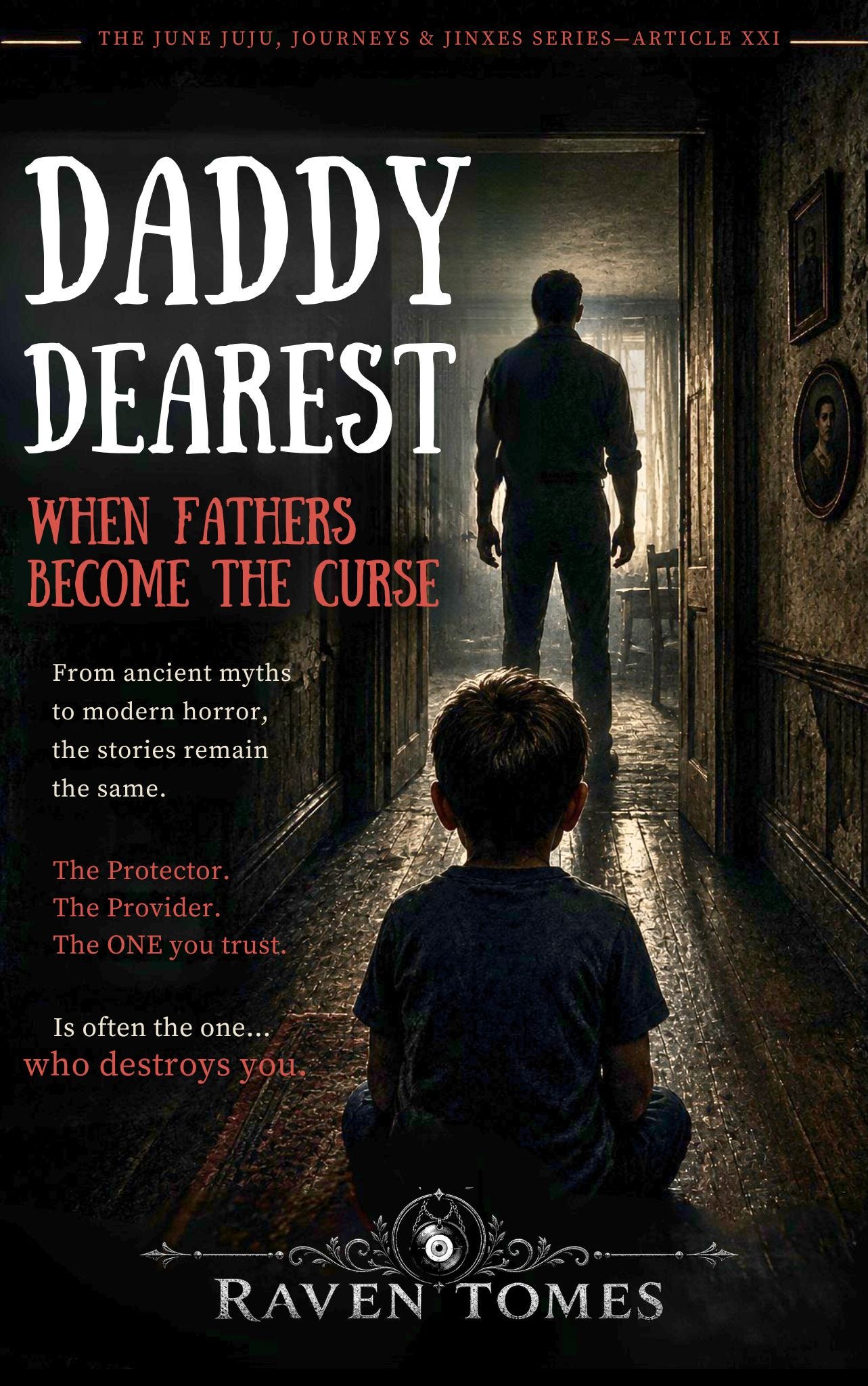
Part of the June JuJu, Journeys & Jinxes Series, where folklore, fate, and superstition reveal the strange lengths people have gone to influence the world around them.
By Raven Tomes
A father is supposed to stand between his family and the darkness.
That expectation is woven into mythology, folklore, religion, and storytelling alike. Fathers are the ones who check beneath the bed when children hear something moving in the shadows. They answer the door when danger arrives. They reassure their families that everything will be alright.
Horror begins when that promise is broken.
Not because the father fails to protect his family, but because he becomes the thing they need protection from.
Few figures are more unsettling than a corrupted protector. The stranger outside the house is expected. The creature lurking in the woods belongs there. Even the ghost haunting an abandoned building feels predictable. The monster hiding inside the home is something else entirely because it violates the one thing every family depends upon.
Trust.
The oldest stories understood this long before horror became a genre.
One of the earliest examples appears in Greek mythology. Cronus, king of the Titans, learned of a prophecy foretelling that one of his children would overthrow him. Terrified of losing power, he swallowed each child at birth. The story is often remembered for its spectacle, but beneath the mythology lies something deeply human: a parent so consumed by fear and control that he destroys the very people he is meant to protect.
The first horror father was not a monster emerging from the wilderness.
He was sitting at the head of the table.
That pattern never truly disappeared. Folklore repeatedly returned to fathers who abandoned children, traded them away, failed them, or allowed pride and obsession to place their families in danger. The details changed from story to story, but the underlying fear remained remarkably consistent.
What happens when the protector becomes the threat?
The answer is devastating because it transforms the home itself. The woods are supposed to be dangerous. Graveyards are supposed to be dangerous. Ruined castles and abandoned houses are supposed to be dangerous. Home is not.
When that certainty disappears, every room changes with it.
The hallway feels longer. The bedroom door feels thinner. Familiar spaces become unfamiliar because danger is no longer outside the walls. It lives within them.
Modern horror embraced that fear completely.
Perhaps no example is more iconic than Jack Torrance in The Shining. When audiences first meet him, he is not a monster. He is flawed, frustrated, and struggling to rebuild his life. The horror emerges gradually as the Overlook Hotel strips away whatever stability remains. By the time he stalks his family through the hotel’s corridors, the ghosts are no longer the primary threat.
The father is.
What makes Jack frightening is not the axe in his hands. It is the realization that the person pursuing his family is someone they once trusted completely.
The same fear appears throughout horror cinema, though it takes different forms. In The Amityville Horror, the house slowly corrupts George Lutz until the family’s protector becomes a source of instability and fear. In Frailty, a father becomes convinced that God has chosen him to destroy demons disguised as human beings. His certainty is what makes him terrifying. He never sees himself as a villain. He believes he is doing exactly what is right.
History has rarely produced anything more dangerous than someone who is absolutely convinced they are justified.
Other films explore the archetype through failure rather than violence. In The VVitch, the father is not evil, but his pride, stubbornness, and inability to recognize the danger surrounding his family help guide them toward catastrophe. Hereditary presents a father trapped inside a curse he cannot understand, while The Lodge explores the devastating consequences of decisions that ripple outward and destroy lives.
Different stories.
Different fathers.
The same wound.
Each explores the collapse of trust inside a place that should have been safe.
That is why the horror father remains so effective. Most monsters arrive from outside. Vampires must be invited in. Ghosts must find a way through the walls. Cursed objects must be brought home. The corrupted father begins inside the family itself. He already knows the routines, the fears, the vulnerabilities, and the places people retreat when they feel unsafe.
No stranger possesses that advantage.
The betrayal cuts deeper because the trust was real.
Of course, most fathers are not monsters. Most spend their lives doing exactly what stories expect of them. They protect. They sacrifice. They endure hardship so their families can avoid it. That reality is precisely what gives the horror father so much power as an archetype.
The role carries weight.
The trust matters.
The expectation exists.
When those things are broken, the damage feels personal in a way few other horror concepts can achieve.
Perhaps that is the true curse hidden inside these stories.
Not that fathers become monsters.
But that monsters understand the fastest way into a family is through the person everyone believes would never let them in.
We teach children to fear strangers. We warn them about dark roads, abandoned buildings, and things that hide in the woods. Folklore has always been filled with threats waiting beyond the safety of home.
Horror offers a darker possibility.
Sometimes the danger is already inside.
Sometimes the monster does not need to break through a window or force open a door. Sometimes it already knows everyone’s name. It already knows which bedroom belongs to whom. It already understands exactly where the fear lives.
The oldest stories understood this. The most effective horror films still do. Because sometimes the monster is not waiting outside the front door.
Sometimes he is the one holding the key.
And sometimes the thing children fear most is discovering that the person they trust to protect them has become the reason they need protection at all.
 | A guest post by
|
On Father's Day: Luke Skywalker, did you remember to return the phonecall from your Sith Lord??
Very sad to read Raven’s notes to her YouTube followers on why she had to leave the platform. We will all miss “Raven’s Reading Room.” Check it out now while her spooky content is still available.