
The Empty Seat

May Mirth, Maladies & Manifestations — Article IX
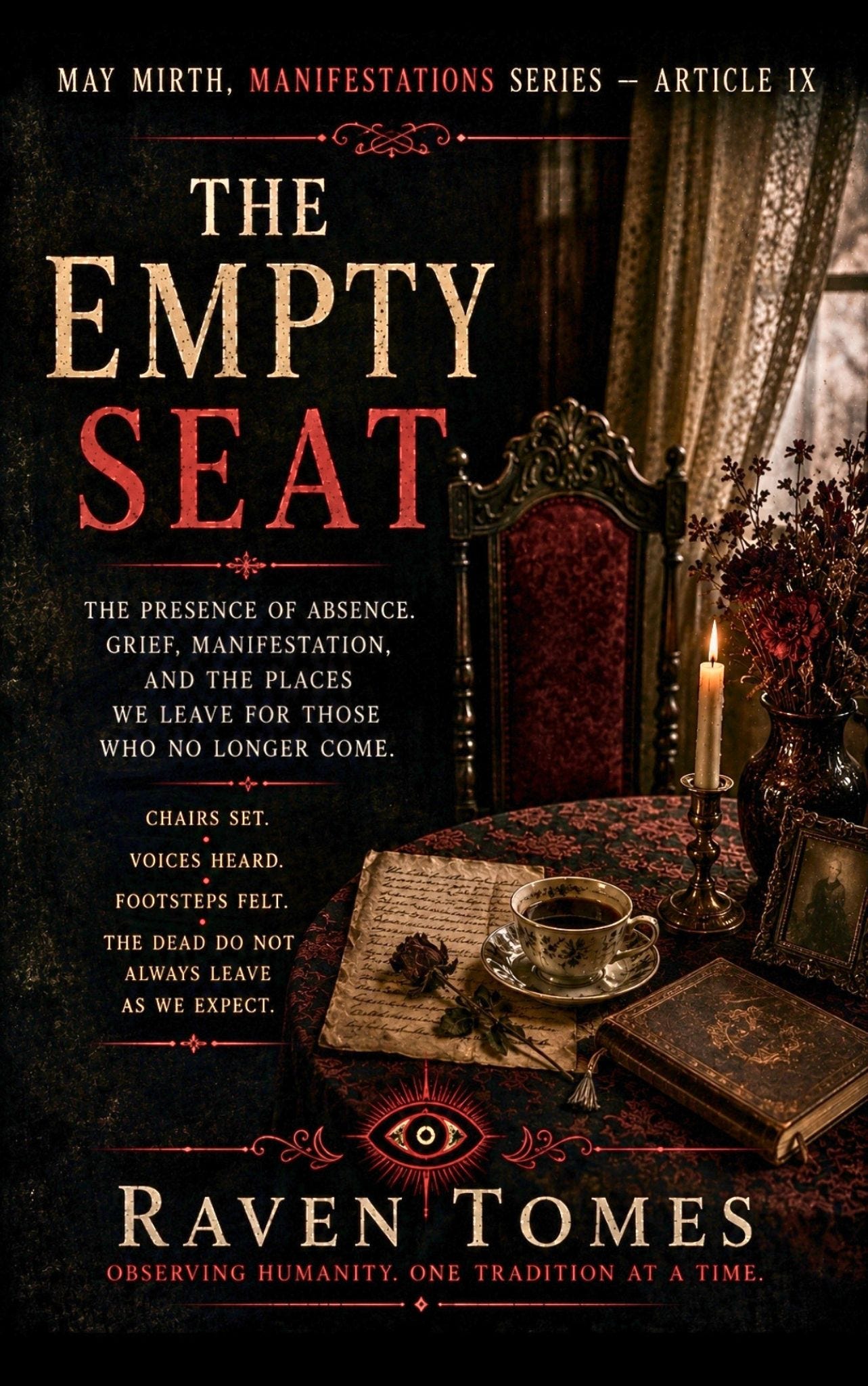
Part of the May Mirth, Maladies & Manifestations Series, where what’s celebrated, what’s suffered… and what’s seen are never the same thing.
By Raven Tomes
There is a moment after someone dies when the world becomes disturbingly inconsistent.
Not dramatically.
Quietly.
Their jacket still hangs where they left it. Their favorite mug remains near the sink. Their side of the bed stays slightly indented for days afterward, as though the body itself has not fully accepted the change.
And sometimes, neither has the mind.
Across cultures, throughout history, people have described the strange sensation of someone remaining present after death. A figure glimpsed in the hallway. Footsteps in an empty room. A familiar voice mistaken for background noise. The unmistakable feeling that someone is sitting nearby despite knowing no one is there.
Modern psychology often refers to these experiences as bereavement hallucinations or sensed presence phenomena. Studies have shown they are surprisingly common among grieving individuals. Some report hearing conversations. Others smell perfume, cigarette smoke, aftershave, or perfume associated with the deceased. Some briefly see movement from the corner of their eye. Others wake convinced someone had just sat down beside them.
And perhaps most unsettling of all, many people who experience these moments do not describe them as frightening.
Only familiar.
Historically, entire traditions formed around the idea that the dead linger briefly after passing. Mirrors were covered. Clocks were stopped. Chairs were left empty during meals or gatherings as symbolic acknowledgment that someone missing still occupied emotional space within the home.
Even now, people instinctively preserve absence in strangely physical ways.
An untouched seat at the dinner table.
A side of the closet left alone.
A phone number never deleted.
The human brain appears deeply resistant to sudden disappearance.
Neurologically, this may make sense. Human beings are pattern-dependent creatures. We memorize routines, sounds, movement, timing, and presence. The brain becomes accustomed to expecting certain people in certain places. When someone dies, those patterns do not vanish immediately.
Expectation survives longer than reality.
Which may explain why grief can feel less like losing someone all at once and more like repeatedly discovering their absence over and over again.
A hallway glance.
A passing silhouette.
The split-second certainty that someone just entered the room.
And then the correction.
No one is there.
But manifestation has always existed in the space between certainty and perception.
Hospitals, nursing homes, and hospice workers have long shared stories about patients speaking to unseen visitors shortly before death. Family members describe clocks stopping at precise moments. Empty rooms feel occupied. Pets react to corners no one else notices. Entire cultures built folklore around the belief that emotional attachment leaves impressions behind.
Whether paranormal or psychological, the result remains disturbingly similar.
Absence develops weight.
And humans seem remarkably unwilling to leave it empty.
Perhaps that is why the image of the empty chair unsettles people so deeply.
It represents more than someone missing.
It represents the lingering expectation that they should still be there.
That the mind has not fully released the outline of a person from the space they once occupied.
Maybe that is all manifestations truly are.
Not ghosts.
Not hauntings.
But the human mind struggling against erasure.
Because some people leave rooms long before their presence leaves us.
👁👁👁
The dead do not always remain because they refuse to leave.
Sometimes they remain because part of us refuses to stop looking for them.
~~~
Some stories don’t end here. Subscribe before the next one finds you.
 | A guest post by
|